|
|
 |
|
G U I L H E R M E A. S. P E R E I R A
Research
This page summarizes some of the research I've been done in the last few years.
Guidance - We are very interested in the determination of novel and efficient strategies to guide mobile robots in large, sparsely occupied workspace. An actual application we are studying now is UAV (Unmanned Air Vehicles) guidance. Our current solutions are based on the discretization of the environment using very large cells, the determination of sequence of cells to be followed, and the computation of a fully continuous vector field inside de sequence of cells.
Swarm Control - Swarms are groups of hundreds or thousands of very simple mobile robots that need to be coordinated and controlled to cooperatively execute a given task. Totally decentralized methodologies, where all agents can be considered anonymous and can be programmed with the same piece of code, must be provided. Furthermore, those methodologies should be robust to dynamic deletion and addition of new robots. One of our proposal to address this problem is to model the swarm as an incompressible fluid immersed in a region where an electrostatic field, which is free of local minima, is defined. More details about this work can be found in my page of publications.
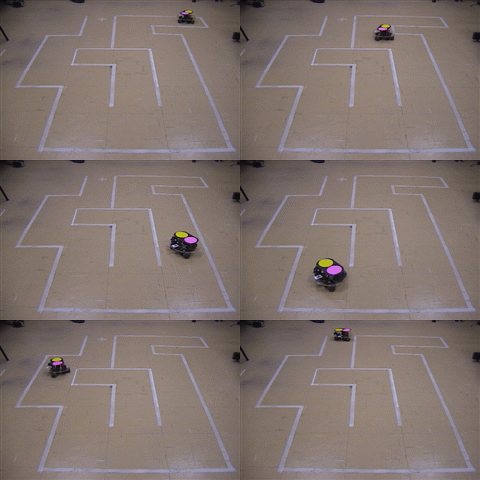
Robot Navigation Functions - Navigation Functions are artificial potential functions defined over the robot configuration with a unique global minimum at the goal configuration. They are used for robot motion planning and control. The main advantage of potential field based approaches for robot navigation is that the integral curves of the vector field formed by the gradient of the potential function define implicit paths from every start robot configuration to the goal configuration. In our research we apply very well know finite elements techniques to efficiently compute navigation functions. The main advantages of our approach include the possibility of dealing with complex shaped robots and obstacles. See a movie (mpeg~2.2M) with a robot been controlled in a maze. For non-circular robots, see this video (mpeg~3.6M) where the robot orientation was taken into account.
Sensor networks - Sensor networks are wireless ad hoc networks where the nodes are basically constituted of a processor with very limited capacity and several sensors. We are interested in using such a network to guide people and robots in unstructured and dangerous environments. In a search and rescue task, for example, a sensor network could be scattered in the environment to help people to find the exit of a burning building. We are also interested of having robots collecting data from a sensor network by visiting each of the sensors that constitute the network.
Cooperative Motion Planning - Our objective with this research is to develop algorithms and techniques to lead a group of mobile robots to specified goals while executing some cooperation. Our approach is to modify individuals plans in real time in order to satisfy constraints induced by the other robots in the group. All controllers are decentralized and are based on navigation functions. Our solution for Multi-Robot Manipulation using object closure is one of the examples of this approach. We also have examples with sensor and communication constraints. See my thesis home page.
Multi-Robot Manipulation – The objective of this research is to perform the coordination of a team of mobile robots in object manipulation tasks. I’ve been working in two different approaches:
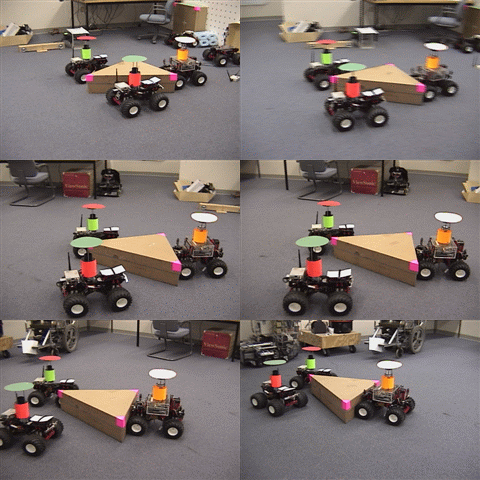
Object Closure – We have developed a new manipulation technique in which the robots do not need to keep force or form closure constraints in order to manipulate an object. Object closure requires the less stringent condition that the object is trapped or caged by the robots. Here (mpeg~2.5M) you can see how the robots compute in real time the object closure condition. This video (mpeg~3.5M) shows a group of tree car-like robots transporting an object using object closure. This is research was developed at the GRASP Lab. of the University of Pennsylvania.
Object Carrying – In this approach the robots must carry an object from an initial position to a goal. We coordinate the robots using implicit communication and a dynamical leader-follower architecture. More details about this work can be found in my page of publications. A video (mpeg) of our two Lego robots, Manuelzão and Miguelin, carrying a box can be downloaded from here(~12M).
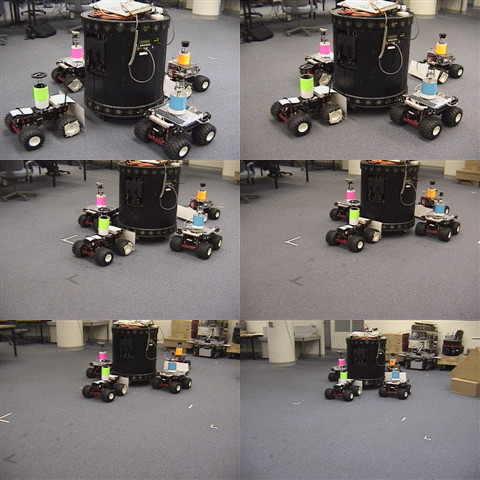
Cooperative Sensing – In this research the objective is to combine the information from multiple mobile robots in other to construct a data basis that is more robust, precise and complete than the information from a single robot. This example (mpeg~6M) shows three robots cooperatively tracking a box by its corners. Observe in this movie (mpeg~3M) that even if one robot is blind it continues tracking the box using the information from the others.
Vision Based Control – We first started working with vision based control in order to improve our robot soccer team. The team of three soccer players was controlled based on images from an overhead camera. The control problem in this case is the big delay in the system. Although today, with the new computers and frame grabbers this is not a big deal, in that time (~1997) we solved the problem using a model predictor in the control loop in other to compensate the delay. You can download three videos of the robots been controlled in predefined trajectories: sinusoid (mov~9M), circle (mov~7M) and 2 robots (mov~8M). Other examples of video based control can be found in the videos on object closure. In those movies the robots are controlled to the goal using visual servoing.
Robot Development – I've been developing several kinds of mobile robots. Most of time our robots are used for research only, but recently we've built a robot to a real world task. This robot is able to install and remove signaling devices in aerial power transmission lines. You can download two movies: installation (avi~3M) and removal (avi~4.5M). You need a special codec (zip~700K) to play the movies.
|
|
|
|